Security
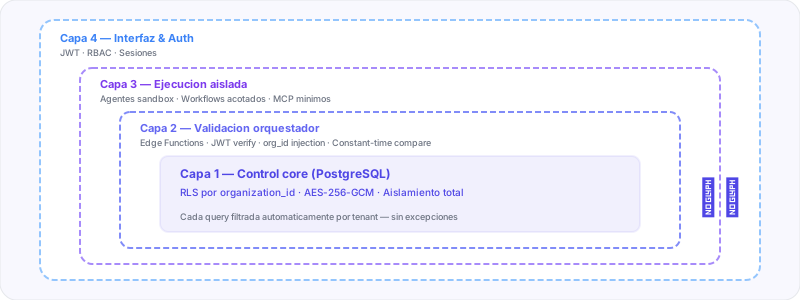
Security in BiVelio follows a Zero Trust model with four defense layers. Every component of the system operates on the principle of least privilege, and every operation is logged for auditing purposes.
Core principles
| Principle | Implementation |
|---|---|
| Zero Trust | Every request is authenticated and authorized, without exception |
| Least privilege | Each component accesses only the data it needs |
| Defense in depth | 4 independent security layers |
| Full auditability | Every operation is recorded with traceability |
Security layers
Layer 1 — Core control (database)
- Row Level Security (RLS) — isolation by
organization_idon all tables - Every query is automatically filtered by the authenticated user’s organization
- Impossible to access data from another workspace, even in the event of code errors
Layer 2 — Orchestrator validation
- Edge Functions validate the user’s JWT or service role key on every request
- The
org_idis extracted from the token and injected into all queries - Constant-time key comparison to prevent timing attacks
Layer 3 — Isolated execution
- AI agents operate in a sandbox without direct database access
- Workflows execute each node with scoped permissions
- MCP integrations operate with minimal credentials per provider
Layer 4 — Interface and authentication
- Authentication via Supabase Auth (JWT)
- RBAC with 3 roles: Super Admin, Process Admin, Operator
- Sessions with configurable expiration
- No plain-text password storage
Encryption
Data in transit
- TLS required for all communications
- HTTPS enforced on app.bivelio.com and all Edge Functions
- Certificates managed automatically
Data at rest
- MCP integration credentials encrypted with AES-256-GCM
- OAuth tokens (Google, WhatsApp) encrypted with the same standard
- Key derivation via PBKDF2 with 100,000 iterations
- Storage format:
enc:v1:<base64>(versioned for future rotation) - Server secrets stored with 0600 permissions (root only)
Encryption keys are never stored alongside the encrypted data. Key rotation is possible thanks to the version prefix in the storage format.
Multi-tenant isolation
BiVelio is multi-tenant by design. Isolation is guaranteed at the database level:
- Every relevant table includes
organization_idas a partition column - RLS policies active on all tables with tenant data
- Indexes optimized for filtering by organization
- Edge Functions always inject the
org_idfrom the authenticated token - No endpoint returns cross-tenant data
RBAC — Role-based access control
| Role | Permissions |
|---|---|
| Super Admin | Full access: configuration, users, billing, integrations |
| Process Admin | Process management, cases, workflows, and agents |
| Operator | Day-to-day operations: support, assigned cases, tasks |
Permissions are enforced both on the frontend (UI visibility) and on the backend (RLS policies and Edge Function validation).
Compliance
GDPR (General Data Protection Regulation)
- Data stored in the EU
- DPA (Data Processing Agreement) signed with infrastructure providers
- Right of access, rectification, and erasure implemented
- Consent log and legal basis per operation
LQPD / APDA (Andorran framework)
BiVelio complies with the Llei Qualificada de Protecció de Dades of Andorra:
- Data residency compatible with the Andorran framework
- Technical and organizational measures (TOM) documented
- Classification of personal data by category
Personal data processed
| Category | Examples |
|---|---|
| Master data | Name, email, phone, address |
| Communication data | Messages, emails, calls |
| Contractual data | Cases, invoices, services |
| Log data | Accesses, operations, timestamps |
| Payment data | Managed by Stripe (PCI DSS) |
Mandatory human-in-the-loop
Certain critical operations require explicit human confirmation:
- Payments and financial transactions
- Data deletion
- Changes to critical workspace configuration
- Mass communications
- Deploying changes to production
No AI agent or automation can execute these operations without explicit approval from an administrator.
Infrastructure
- Edge Functions — Supabase (Deno runtime, per-request isolation)
- Database — PostgreSQL with native RLS
- Frontend — Vercel (global CDN, automatic HTTPS)
- VPS (BiVelio AI Brain) — Hetzner (EU), UFW active, SSH key-only, automatic backups
- Payments — Stripe (PCI DSS Level 1)